Author: broker

  • T-bills prices keep plunging in nine months

    T-bills prices keep plunging in nine months

    Treasury bills’ minimum successful bids and weighted average prices have been decreasing consecutively in the last nine months throughout the year.

    The bills’ prices on average have dropped from their highest of 99/84 in the auction held last August to 99/67 in the auction held on the third day of May.

    Tanzania Securities’ Treasury Bills Analysis report issued yesterday showed that the last five auctions recorded the same price of 99/67.

    “Investing in Treasury bills may not make sense, especially for individual investors seeking higher yields and optimum long-term growth.”

    However Treasury bills are considered low-risk investments offering competitive yields compared to other similarly safe investments, such as bank savings accounts, the Tanzania Securities report said.

    The 364 bill offers yields of 7.22 per cent.

    However, the report said, the bills are crucial and valid to institutional investors such as banks and insurance companies for liquidity purposes.

    On the other hand, the T-bills weighted average yields have improved from their lowest value of 1.68per cent recorded last August to 3.45per cent at the last auction.

    Additionally, unlike other bills, the 364 days T-bill has the highest investor appetite among the four T-bills because it is the most transacted.

    “The T-bill has been transacted in all the past 23 auctions and with it being oversubscribed in most of the auctions.

    “The yield trend of the 364-day bill has been increasing throughout the year,” the report said.

    The 364 days T-bill yields have improved from 3.3 per cent reported on the auction that occurred last May to the all-time high of 7.2 per cent recorded on the auction conducted in mid-January.

    Also, unlike other T-bills, the weighted average price of 364-day is always higher than the minimum successful bid because of the large number of bids at different prices.

    The 182-day T-bill’s weighted average yield keeps on increasing while prices drop. The bill recorded the highest price of 99/16 with the lowest yield of 1.7per cent in the auction held last May. On February 8, the bill recorded the highest yield of 5.23 per cent with the lowest price of 97/46. On the last traded auction, the bill recorded a yield of 5.4 per cent with a price of 97/38.

    “The 91-day T-bill has a similar characteristic to that of the 35-day bill in that both minimum successful bids and weighted average prices have been decreasing throughout the year,” the analysis said.

    The weighted average prices of 91 days have dropped from the highest of 99/41 recorded last June to 99/20 recorded on the last auction.

    While the weighted yield also improved from 2.4 per cent to the highest of 4.0 per cent recorded on the last auction.

    Additionally, the 35 days T-bill minimum successful bids and weighted average prices have been decreasing throughout the year.

    Prices have dropped from their highest of 99/84 in the auction held last August to 99/67 in the auction held on May 3, which was similar to the prices of the last five auctions.

    However, the 35-day weighted average yields have improved from their lowest value of 1.68 per cent recorded last August to 3.45 per cent at the last auction.

    The 364-day Treasury bill is the most transacted security, transacted in all 23 auctions, followed by the 182-day, which was transacted in 15 out of 24 auctions and the 91-day was transacted in 11 auctions, the same as 35-day T-bills.


  • DSE returns to bull ran

    DSE returns to bull ran

    Activities on the Dar es Salaam Stock Exchange (DSE) increased for the second week running.

    Turnover for the week amounted to 3.9bn/-, an increase of 48.20 per cent from the previous week. General market was in bullish mode leading to an increase in both total and domestic market capitalisation.

    The top three trading counters within the week were, TBL, CRDB, and NMB, dominating the market with 57.44 per cent, 27.42 per cent, and 10.41 per cent of the overall market turnover, respectively.

    Four counters registered price gains within the week, Simba Cement (TCCL) leading the gainers as the Scancem acquisition seems imminent.

    Simba cement registered 28.38 per cent gain within the week closing at 1,900/- per share, SWISS gained 6.49 per cent per week ending the week at 1,640/-. NICO as well registering a 2.5 per cent gain within the week closing at 410/- per share, lastly CRDB registered a 2.04 per cent increase within the week to close at 500/- per share

    On the loser’s side, DCB Bank dropped by 2.63 per cent closing off the week at 185/- per share.

    Total market capitalisation increased by 2.12 per cent to 15.151tri/- and domestic market capitalisation increased by 0.52 per cent closing at 10.934tri/-.

    Key benchmark indices

    • All Share Index (DSEI) closed at 1,816.97 points increasing by 2.12 per cent.
    • Tanzania Share Index (TSI) closed at 4,133.050 points increasing by 0.52 per cent.

    Sector Indices

    • Industrial and Allied Index (IA) closed at 5,128.51 points, up by 0.46 per cent.
    • Bank, Finance and Investment Index closed at 4,029.69 points, up by 0.82 per cent.
    • Commercial Services Index closed at 2,161.21 points, down by 0.20 per cent.

    Highlights: Debt Market

    Primary market

    On Wednesday 17th May 2023, the central bank was in the market offering 103bn/- to investors for a new 5-year Treasury bond offering an 8.6 per cent coupon rate annually.

    This auction was catered for investors with more preference for medium-term papers.

    The auction was subscribed by 46.17 per cent – the auction received bids totalling 47.55bn/- and accepted bids worth 44.15bn/-.

    The weighted average yield to maturity has gone up by 17.87 basis points relative to the previous auction held on January 4th 2023 from 9.6670 per cent to 9.8457 per cent.

    Average yields have been on an upward trend over the last four auctions gaining 90.77 basis points from the average yield in May 2022. Moreover, the price floor has reached 92.4 from 96.5 in the same period.

    This continues to reflect lessened monetary policy accommodation by the central bank to taper inflation.

    This 5-year Treasury bond had been undersubscribed, as were the previous two 5-year auctions. This reflects investor’s current appetite for long tenures such as the 25-year Treasury bond due to its higher cash flow appeal.

    Additionally, the recent increased stock market activity can also explain the low auction subscription as higher-risk investors’ shift to equities.

    Secondary market

    Market activities were elevated during the week, the overall turnover for the trading week ending May 19 increased by 114 per cent from 61.68bn/-registered in the previous week to 132.34bn/-.

    Moreover, number of trades increased from 45 trades recorded in the previous trading week to 58 trades.

    Overall tenures traded were predominately on the long end of the of the yield curve, the on-the-run 20-year T-bond accounting for 45.33 per cent of the traded volume.

    There was a fixed income trade during the week involving a NMB corporate bond with a notional value of 6.0m/- and an average price of 85/94.  We expect secondary trading activities to remain elevated in the coming weeks.

    Inflation

    Inflation rate drops to 4.3 per cent after slightly going down by 0.4 percentage points in April, after the prices of some food and non-food items slightly declined.

    The national bureau of statistics (NBS) statement on Wednesday showed that inflation dropped to 4.3 per cent from 4.7 per cent in March.

    Impact

    The decline in the inflation rate might be a positive sign that the government’s efforts to contain and maintain the inflation rate are working. This creates favourable conditions for investment for both international and domestic investors.

    Outlook

    Domestically, we understand equities strategies for 2023 should be focused on companies with solid fundamentals, which will show more growth. From a macro-economic perspective, low inflation and resilient cost pressures will be key drivers to compliment the quality of Tanzania equities. Given the strong growth environment in the companies are expected to increase top line and bottom-line growth relative to FY 2022.

    In the short-term we might see slight volatility in the weeks ahead as companies begin to exercise their corporate actions.

  • TMRC bond attracts more local investors

    TMRC bond attracts more local investors

    THE Tanzania Mortgage Refinance Company Limited (TMRC) has listed on the Dar es Salaam Stock Exchange (DSE) the 4th tranche bond of which all of its investors are locals.

    Compared to the previous tranches, luring more Tanzanian investors brings more hope for increasing the liquidity in the capital market.

    Moreover, retail investors scoped a big chunk with 69 per cent against 31 per cent of corporate investors during the public offering.

    During the public offering which was opened on April 3, until April 24, the TMRC targeted to collect 10bn/- but it successfully oversubscribed by collecting 11.28bn/-, equivalent to 112.8 oversubscriptions.

    Speaking at an event to grace the listing of the bond over the weekend, Commissioner for Debt at the Ministry of Finance and Planning, Mr Japhet Justin, pointed out that the move would give more opportunities to people to invest and list their shares on the DSE.

    “When we raise funds for the mortgage refinancing, we should also consider how we can reach out to more people for mortgage loans,” Mr Justin challenged as he commended the TMRC for consistently listing the tranches of the bond on the DSE.

    He argued that mortgage contribution to the Gross Domestic Product (GDP) was still minimal, below one per cent, hoping that as more people invest in the DSE the sector’s contribution would increase.

    Chief Executive Officer of the Capital Market and Securities Authority (CMSA), Mr Nicodemus Mkama, said the sale of the TMRC bond has been positive in the development of the capital market and finance sector at large in the country.

    Mr Mkama noted that 69 per cent being retail investors shows a positive gesture in the implementation of the National Financial Inclusion Framework which intends to increase the participation of citizens in the formal financial sector, including the capital market.

    He attributed the success to the ongoing public awareness campaigns over the benefits of investing in the capital market.

    Mr Mkama further argued that the achievement was a result of the presence of an enabling environment offered by the government.

    Commenting, the Acting Chief Executive Officer of the DSE, Ms Mary Mniwasa, said in the past 12 months the DSE has listed four bonds worth 135bn/-.

    However, she said the demand was quite high for corporate bonds despite the global economic crunch.

  • CRDB to pay record Sh117.5 billion in total dividend to its shareholders

    CRDB to pay record Sh117.5 billion in total dividend to its shareholders

    Arusha. Shareholders of CRDB Bank Plc will get a total of Sh117.5 billion in dividends this year, thanks to the lender’s improved profitability in 2022. This represents a roughly 25 percent increase over the Sh94 billion total dividend the bank paid its shareholders last year from its 2021 net profit.

    The bank’s shareholders will receive a dividend per share of Sh45 billion this year, up from last year’s Sh36 billion. “The rise in our profitability and hence our dividend is testament to the success of our five-year medium strategy that ran from 2018 to 2022,” CRDB Bank board chairman Ally Laay told shareholders here at the weekend.

    At group level, CRDB Bank’s net profit rose by 31 percent last year to reach Sh351.4 billion, compared to Sh268.2 recorded in 2021.

    He said CRDB Bank’s Burundi subsidiary exhibited a splendid performance last year when its net profit rose by about 80 percent to reach Sh23 billion from Sh12.8 billion in 2021.

    “This means that the Burundi subsidiary alone contributed 7.0 percent to the Group’s profit,” he said, detailing a number of initiatives that the board and the management will undertake to grow the profits further in that country.

    Recently, CRDB Bank was granted a licence by the central bank of the Democratic Republic of the Congo, officially known as Banque Central du Congo (BCC), to commence its operations there.
    Similarly, CRDB Bank Group has also introduced an insurance subsidiary, CRDB Insurance Company (CIC), as well as its own foundation this year.

    Speaking on the Bank’s performance, the Group CEO and Managing Director, Abdulmajid Nsekela, said in the financial year 2022, the efforts to strengthen income continued to yield positive results, with a growth of 28 percent in operating income to Sh497.7 billion.

    The growth was fueled by an increase in net interest income, which grew by 15.5 percent year-on-year to Sh745.8 billion, driven by loan book growth. The Group closed the year with an NPL ratio of 2.8 percent, thus meeting the regulatory requirement of less than 5 percent.

    The Bank also recorded strong balance sheet growth, with a year-on-year expansion of 32.0 percent from Sh8.8 trillion in 2021 to Sh11.6 trillion. The growth was contributed by a 26.4 percent increase in customer deposits, reaching Sh8.2 trillion from Sh6.5 trillion reported in 2021.

    “Our efforts to enhance the efficiency of our operations continue to bear results with significant improvements in our cost of business as reflected in the cost-to-income ratio, which has improved significantly from 66.7 percent in 2018 to 49.4 percent in 2022,” he said.

  • CRDB Dividend Declaration Notice – Year 2022

    CRDB Dividend Declaration Notice – Year 2022

    Notice is hereby given that dividend of TZS 45 per share in respect of the
    financial year ending 31 December 2022 has been proposed by the Board of
    Directors. Pursuant to this declaration, shareholders are advised to observe the
    following:
    Dividend Declaration Date:  28th April 2023
    Trading of Shares cum Dividend: 28th April 2023 to 18th May 2023
    Trading of Shares Ex Dividend: 19th May 2023 onwards
    Closure of the Members Register: 23rd May 2023
    Re – opening of the Register: 24th May 2023
    Dividend Payment Date: 05th June 2023

    Shareholders are requested to submit and update their payment details at the
    Share Registry Office to enable the timely payment of their dividends.

    Shares Registry Office
    CRDB Head Quarters – 10th Floor
    Cnr. Ali Hassan Mwinyi Road/Obama Drive, Dar es Salaam, Tanzania
    E-mail – shares_unit@crdbbank.co.tz
    Mob number: 0755 197 700
    WhatsApp number: 0767 757 215

    BY ORDER OF THE BOARD
    John Rugambo
    Company Secretary
    28th April, 2023

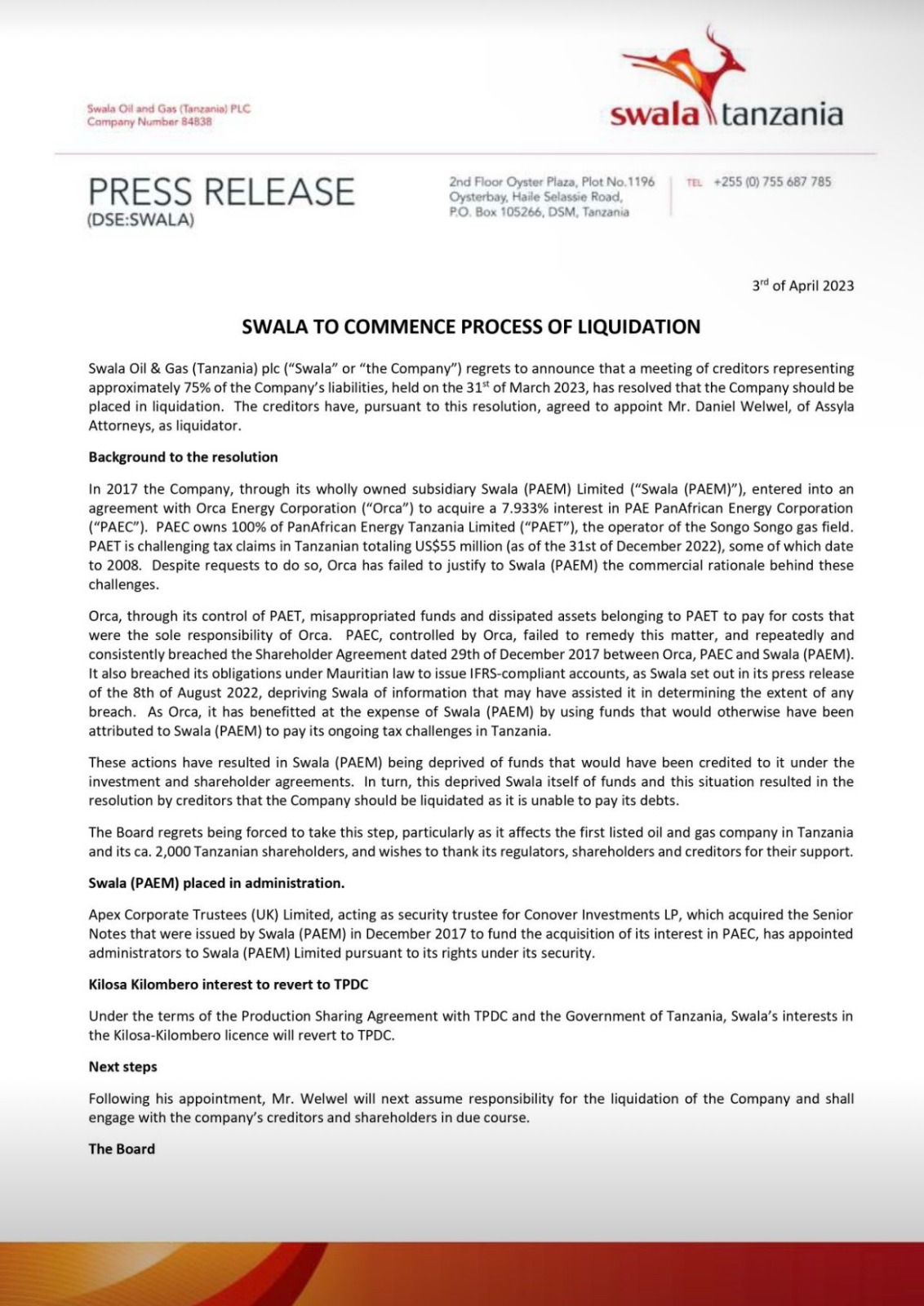
  • SWALA OIL & GAS PLC TO COMMENCE LIQUIDATION PROCESS

    SWALA OIL & GAS PLC TO COMMENCE LIQUIDATION PROCESS

    The announcement states that Swala Oil & Gas (Tanzania) plc will be placed in liquidation as per the resolution of its creditors representing approximately 75% of the Company’s liabilities.


  • CRDB Bank targets bigger pie of the blue economy proceeds in the Spice Islands

    CRDB Bank targets bigger pie of the blue economy proceeds in the Spice Islands

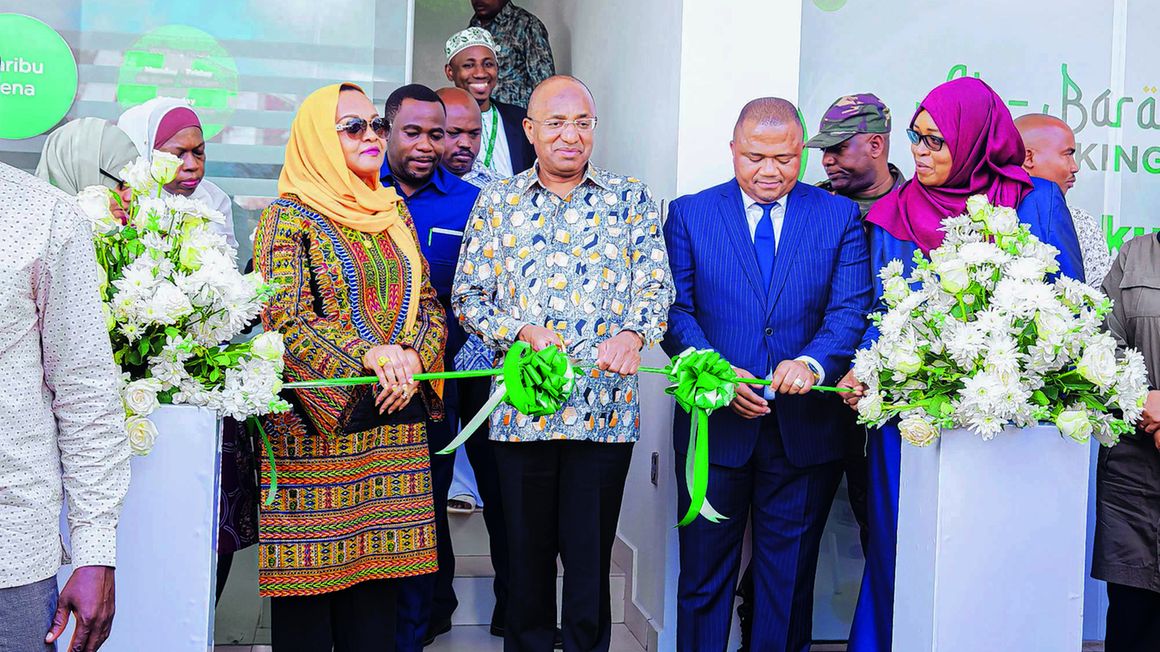
    Pemba. CRDB Bank yesterday opened a branch in Wete, Pemba as it seeks to play a role in supporting Zanzibar’s economic growth aspirations, particularly, through the government’s blue economy model.

    Zanzibar President Hussein Ali Mwinyi graced the branch opening event, which also involved the distribution of over 272 motorcycles and 94 boats to economic undertakings owned by the youth and women groups in the Isles.

    In February, this year, Zanzibar government and CRDB Bank signed an agreement that will have the latter disbursing Sh81.8 billion to stimulate economic activities in the Isles.

    The package encompasses Sh60 billion that will be disbursed in form of interest-free loans to income-generating groups in Zanzibar while the remaining Sh21.8 billion will be allocated for improvement of the necessary infrastructure in the Isles that will enable the income-generating groups to conduct their undertakings in modern facilities.

    CRDB Bank’s managing director Abdulmajid Nsekela said since February, the lender has already disbursed a total of Sh6.7 billion in interest-free loans to entrepreneurs in Zanzibar whereby Sh2.8 billion has gone to Pemba.

    “I thank the government for entrusting us with the management of its Sh60 billion fund for loaning to SMEs under the blue economy model. This trust is what has led us to expand our branch network to Wete District in North Pemba,” Mr Nsekela said.

    The beneficiaries include 6,178 women and 5,628 men.

    The Wete Branch will offer both traditional and Islamic banking services.

    The branch opening also saw the bank handing over Sh273.8 million to Shirikani, Umoja ni Nguvu and Mategemeo cooperative societies in the Isles.

    In his remarks, Dr Mwinyi said the disbursement of the funds was in line with his campaign pledge of lifting lives of the people of Zanzibar through the blue economy model.

    “We have promised and now we are implementing. As soon as I was sworn in, I asked banks to open more branches in Unguja and Pemba and CRDB Bank has been in the forefront of implementing my wish,” Dr Mwinyi said as he graced the opening CRDB’s Wete Branch in North Pemba along Mtemani Road at Sunda.

  • Tanzania: Dar Port Strengthens Regional Market Share

    Tanzania: Dar Port Strengthens Regional Market Share


    SIGNIFICANT expansion and improvement of efficiency at Tanzania’s principal port of Dar es Salaam has enabled it to offer faster and cost-effective trade and transport solutions compared to other seaports in the region, a new report by GBS Africa has shown.

    According to the dossier by the advisory services firm, Dar es Salaam Port is becoming a regional transshipment hub for exports and imports for both Tanzania and its land-linked countries in the East African Community (EAC) and Southern African Development Community (SADC).

    “Land-linked countries like the Democratic Republic of Congo (DRC), Malawi, Uganda, Zambia, Rwanda, and Zimbabwe are increasingly opting for Dar es Salaam Port,” reads part of the report.

    The report mentioned some of the products which are transported through the harbour as metals like copper as well as agricultural produce such as tea, coffee, tobacco, oilseeds, cotton, sisal, and cashew nuts.

    The port of Dar es Salaam is one of three major ocean ports in Tanzania and handles over 95 per cent of the country’s international cargo traffic.

    “Although it is smaller than Durban (South Africa) and Maputo (Mozambique), Dar es Salaam port is fast catching up on the market share for Indian Ocean commerce and trade,” the report stated.

    The Dar es Salaam port is designed to handle more than 10 million tonnes of cargo annually including approximately four million tonnes of dry general cargo, six million tonnes of liquid bulk, and one million tonnes of containers.

    An expansion programme namely Dar es Salaam Maritime Gateway Programme (DMGP) is being implemented by the Tanzania Ports Authority (TPA) to improve efficiency in handling cargo and will cost at least 421 US million dollars (about 968.3bn/-) upon its completion in 2024.

    Commenting on the report, GBS Africa’s Managing Partner, Ms Agnes Gitau, said for the African continent to be fully integrated and for the vision of the African Continental Free Trade Area (AfCFTA) to be realised there is need to invest in Africa’s ports.

    A separate report issued in 2016 by the United Nations Economic Commission for Africa (UNECA) pointed to the importance of sea ports in facilitating trade and investments in the continent.

    “In Africa as with the rest of the world, the importance of seaports to trade, and therefore, to the continent’s economic performance cannot be overstated.

    “Ports are crucial for trade of most African countries due to the continent’s high dependency on exports of raw materials and imports of food, manufactured goods and fuel,” UNECA said in the report.

    According to the report by UNECA, more than 90 per cent of Africa’s total trade (including imports and exports) pass through seaports.

    “This demonstrates the importance of having well-managed, transparent and efficient operations and management at Africa’s ports,” the report read in part.

    While expansion projects and purchasing of modern equipment at the Dar es Salaam Port are ongoing, the government has also been eager to attract businesses and investment which in turn increases imports and exports through the country’s ports.

    Since President Samia Suluhu Hassan assumed the country’s top office in March, last year, attracting businesses and investment has been among her top priorities.

    The DMGP is carried out with funds from three sources, including a loan of 345 million US dollars from the World Bank, 12 million US dollars grant from the UK Government’s Department for International Development (DfID) and domestic revenues totaling 64 million US dollars.

    Upon completion of the project in 2024 it would enable the Dar es Salaam Port to handle 25 million tonnes of cargo from the current capacity of handling over 10 million tonnes annually.

    The port will also be able to serve big vessels with length of up to 303 metres which can carry 8,000 containers. That will position the port among ports with capacity and high efficiency in the East African coastline.

  • Cement firms on a roll despite delayed merger

    Cement firms on a roll despite delayed merger

    Dar es Salaam. Investors have maintained a bullish outlook for Tanga Cement Company Limited and Twiga Cement despite delays in the cement manufacturers’ merger plan, available data shows.

    An analysis of the two firms’ performance at the Dar es Salaam Stock Exchange (DSE) shows that the two firms, which performed well during the first half of the year, have maintained that positive trend throughout the first three weeks of July.

    Tanga Cement shares closed at Sh1,460 during the last day of trading in June but had since jumped to Sh1,680 as of Friday, July 22, 2022.

    On the other hand, the share price of Twiga Cement – which trades as Tanzania Portland Cement Company Ltd (TPCC) – rose to Sh3,900 last week, from Sh3,720.

    Analysts say with infrastructure improvement remaining a top priority for the government, investors remain optimistic that even if the merger fails, the two firms will continue to do well in the market.

    “The way we see it is that Twiga Cement is already a mature company and it needs a room to breathe/expand going forward. Availability of quality limestone is a critical part in cement manufacturing and Tanga acquisition decision could not be more appropriate,” said the capital markets manager from Vertex International Securities Ltd, Mr Ahmed Nganya.

    During the year ending December 2021, Twiga recorded a net profit of Sh88.48 billion while Tanga Cement reported an annual net profit of Sh3.7 billion. That was an encouraging comeback from a Sh2.1 billion annual loss it incurred in 2020.

    The acquisition deal was announced last year where Scancem International DA (Scancem), a subsidiary of Heidelberg Cement AG, which owns Twiga Cement, and AfriSam Mauritius Investment Holdings Limited, owner of Tanga Cement, announced that they had finalized the terms upon which the former would acquire 68.33 percent of shareholding in Tanga Cement.

    However since then the deal – which was slated to be finalised by the end of second quarter – has been delayed due to some regulatory issues.

    “Twiga Cement is one of the perennial performers in terms of earnings and price momentum. Acquisition of Tanga would provide room for expansion due to Tanga’s vast and quality limestone resources. Currently, the acquisition has been delayed due to some regulatory hurdles but that is nothing to bother investors,” said Mr Nganya.

    Last week, Twiga emerged as the top market mover at the DSE, accounting for nearly 70 percent of the week’s turnover of Sh1.85 billion.